
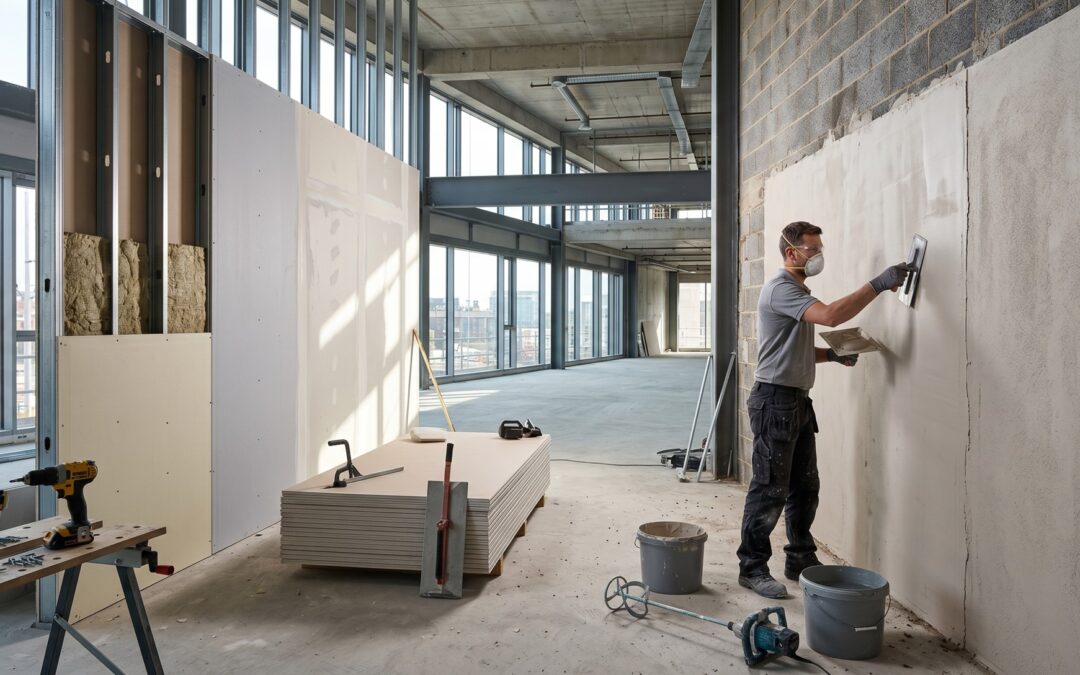
The question that turns up on every programme
Walk into a new commercial unit before the trades arrive, and it feels like a big, echoing promise. Concrete underfoot. Steel above. And that familiar moment where someone asks, “So are we going dry lined, or are we doing it the old way?”
That little fork in the road matters more than people think. It affects the schedule, the snagging list, the way the space performs when it is busy, and even how easy it is to change things later when the tenant has a new idea. Because of course they will.
Somewhere in the middle of all that, the debate of drylining vs traditional plastering always pops up again.
When drylining makes life easier
Modern commercial builds love speed. Drywall installation and commercial drylining systems are made for tight programmes, especially on office fit outs, hotels, retail refits, and big building refurbishment jobs where every day has a price tag attached.
Drylining services are usually quicker to install, particularly for partition walls and larger interior wall systems. You can run services neatly, hit fire and acoustic targets with the right boards, and get a predictable surface ready for decorating. That predictability is underrated, to be honest. Fewer surprises means fewer late nights.
Cost wise, drylining can come out well because labour time is often lower and the process is easier to scale across repeated floors. It also plays nicely with energy efficiency. Add insulation where you need it, tidy up air gaps, and you can lift comfort levels without turning the walls into a science project.
Maintenance is another quiet win. In busy commercial construction settings, things get moved, knocked over, and reconfigured. Drylined walls are often simpler to open up and patch, and they can be designed with access in mind from day one.
When traditional plaster still earns its keep
Traditional plastering is not just nostalgia. In some spaces it is still the better tool.
If you need a tough, dense finish in high traffic areas, think corridors, stair cores, or places where trolleys and chairs seem to aim for the walls. A properly plastered surface can feel more solid and take abuse better. The finish quality can also be gorgeous when you want that monolithic look, especially on feature areas where lighting is unforgiving.
There is a trade off, though. Wet plaster takes time to cure, and that can slow the wider schedule. It is also more sensitive to site conditions. If the building is still drying out or ventilation is poor, you might notice the knock on effect.
Still, for certain plastering solutions, curves, repairs to existing walls, and blending old and new, traditional work can be the calm, steady answer.
Picking what suits the building, not the trend
On large scale commercial plastering packages, the best choice is often mixed. Drylining for speed and service runs. Traditional plaster where impact resistance and a premium feel matter. The smart move is thinking ahead about how the space will be used, cleaned, altered, and occasionally battered by everyday life.
Good drylining contractors and plasterers will talk you through the real world pros and cons, not just what is fashionable. I have seen Plasline do exactly that, weighing the finish, durability, and programme pressure before anyone orders materials.
If you are planning a modern commercial build and want a clear recommendation for your walls and ceilings, take a moment to start the conversation and get a straight, practical view on what will work best.
Recent Comments